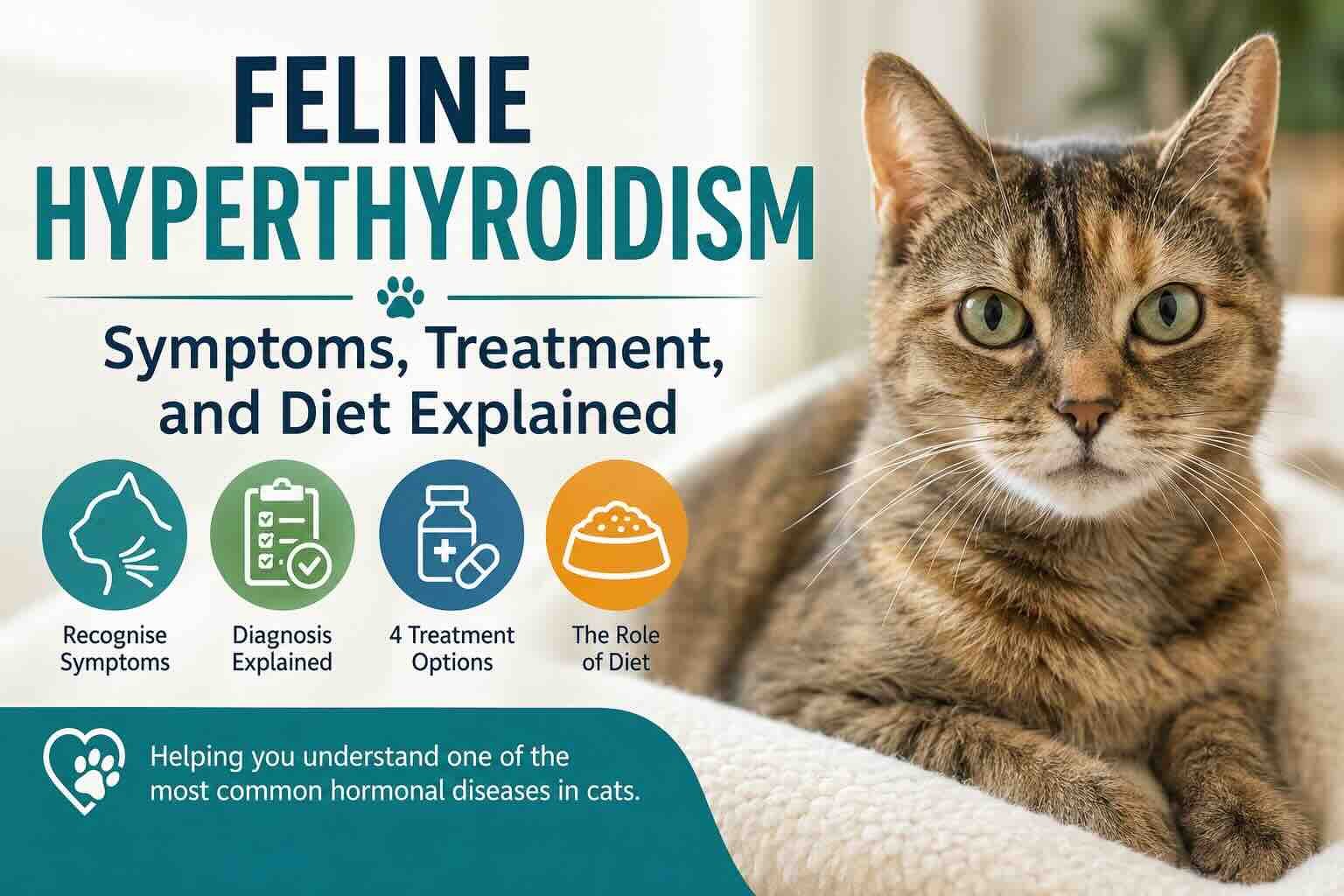
Cat Hyperthyroidism is one of the most common hormonal diseases affecting middle-aged and older cats. Also known as Feline Hyperthyroidism, it occurs when the thyroid gland produces too much thyroid hormone, most often due to a benign (non-cancerous) growth called an adenoma. Because thyroid hormones regulate metabolism throughout the body, excess hormone production may affect the heart, kidneys, and blood pressure over time if the condition is not appropriately managed. Early diagnosis and treatment can help many cats maintain a good quality of life.
What Is Feline Hyperthyroidism?
The thyroid gland, located in the neck, helps regulate your cat’s metabolism by producing thyroid hormones. In cats with hyperthyroidism, one or both thyroid lobes produce excessive amounts of these hormones, causing the body’s metabolism to speed up.
Affected cats may appear unusually energetic for their age while also losing weight or developing changes in appetite, behaviour, or digestion. Some cats may also develop heart-related changes or high blood pressure over time. Signs and severity vary between individual cats, which is why veterinary assessment is important.
The condition is most commonly diagnosed in cats over eight years of age and is uncommon in cats younger than six. Increased appetite combined with weight loss is often considered one of the classic signs, although not every cat presents the same way.
Common Symptoms to Watch For
Cats with hyperthyroidism may develop one or more of the following signs. These symptoms are not specific to hyperthyroidism and may also occur with other medical conditions, so veterinary examination is needed to determine the underlying cause.
- Weight loss despite a normal or increased appetite
- Increased thirst and urination
- Vomiting or diarrhoea
- Hyperactivity, restlessness, or increased vocalisation
- A greasy, matted, or unkempt coat
- Rapid or irregular heartbeat
- High blood pressure, which in some cases may contribute to sudden vision loss
Some cats develop what veterinarians refer to as apathetic hyperthyroidism. Instead of becoming more active, these cats may appear quiet, weak, depressed, or lose their appetite. Because this presentation is less common, it can sometimes be overlooked.
When to Contact a Veterinarian Promptly
If your cat develops any of the following signs, contact your veterinarian or an emergency veterinary clinic as soon as possible. These signs may indicate complications or another serious medical condition requiring prompt assessment.
- Difficulty breathing or open-mouth breathing
- Sudden vision loss or apparent blindness
- Collapse or inability to stand
- Extreme weakness
- A noticeably rapid or irregular heartbeat
These signs do not always mean hyperthyroidism is the cause, but they should never be ignored.
How Vets Diagnose Hyperthyroidism
Veterinarians typically diagnose feline hyperthyroidism using a combination of your cat’s history, physical examination, and diagnostic tests.
These commonly include:
- Physical examination, including feeling for an enlarged thyroid gland
- Blood tests, particularly measurement of total T4 (thyroxine)
- Blood chemistry testing
- Urinalysis
- Blood pressure measurement where appropriate
Kidney function is assessed carefully because hyperthyroidism can sometimes mask underlying kidney disease. Your veterinarian uses these results to determine the most appropriate treatment plan for your cat.
The Four Treatment Options
There is no single treatment that suits every cat. Your veterinarian will recommend an option based on your cat’s age, overall health, kidney function, lifestyle, and the availability of treatment.
1. Anti-thyroid medication (Methimazole or Carbimazole)
Anti-thyroid medication is commonly used as an initial treatment because it is widely available and allows veterinarians to assess how an individual cat responds before considering longer-term options.
The medication reduces thyroid hormone production but does not cure the underlying disease, so ongoing treatment and regular monitoring are usually required. Some cats may experience side effects such as vomiting, reduced appetite, lethargy, or facial itching, although many tolerate treatment well.
Regular blood tests are typically recommended to monitor thyroid hormone levels and overall health.
2. Radioactive Iodine Therapy (I-131)
Many veterinary specialists consider radioactive iodine therapy the definitive treatment for suitable candidates.
A single injection of radioactive iodine selectively targets overactive thyroid tissue while leaving normal thyroid tissue largely unaffected. Published studies report success rates of around 95% in appropriately selected cats, with many returning to normal thyroid function within several months.
Treatment usually requires a short stay in a specialist hospital while radiation levels decrease. Availability varies depending on location and referral centres.
3. Surgical Thyroidectomy
Surgical removal of the affected thyroid gland may provide a permanent solution in appropriately selected cases.
Because many affected cats are older and may have heart disease or other medical conditions, veterinarians often recommend stabilising thyroid hormone levels with medication before surgery.
Whether surgery is appropriate depends on the individual cat and should be discussed with your veterinarian.
4. Prescription Iodine-Restricted Diet
An iodine-restricted prescription diet may help manage thyroid hormone production in some cats when fed exclusively under veterinary supervision.
For this approach to be effective, the cat must eat only the prescribed food, without treats, table scraps, or access to other pet foods. It is not suitable for every household or every cat, so your veterinarian can help determine whether it is an appropriate option.
The Kidney Connection — Why Treatment Can Be More Complex
Hyperthyroidism can sometimes mask underlying kidney disease by increasing blood flow through the kidneys. Once thyroid hormone levels return closer to normal, previously hidden kidney disease may become more apparent.
Because every cat is different, veterinarians often assess kidney function carefully before deciding on the most appropriate long-term treatment. In some cases, a trial period on medication is recommended before considering radioactive iodine therapy or surgery.
Diet and Nutrition After Diagnosis
Even when diet is not the primary treatment, good nutrition remains an important part of managing hyperthyroidism.
Many affected cats lose weight and muscle mass, so maintaining appropriate calorie intake is important. Following treatment, some cats may require ongoing monitoring if thyroid hormone levels become too low.
Nutritional recommendations vary depending on your cat’s overall health, age, and whether other conditions such as kidney disease or heart disease are present. Your veterinarian can advise whether a standard senior diet or a therapeutic prescription diet is most appropriate.
Affiliate Placement
Prescription and senior cat food options (available only under veterinary guidance):
- Hill’s Prescription Diet y/d — formulated to help manage feline hyperthyroidism (veterinary prescription required)
- Royal Canin Renal Support — commonly recommended for cats with concurrent kidney disease where appropriate
- Purina Pro Plan Veterinary Diets — available in a range of therapeutic formulas; your veterinarian can advise which option best suits your cat’s individual medical needs
Always obtain advice from your veterinarian before feeding any prescription therapeutic diet.
Prognosis — What to Expect
With appropriate diagnosis and management, many cats with hyperthyroidism enjoy a good quality of life for many years.
Many cats respond very well to treatment, although recovery time and long-term outcome vary depending on age, kidney function, heart health, and the treatment selected. Cats receiving medication generally require lifelong monitoring, while those treated with radioactive iodine or surgery may achieve long-term control or resolution of the condition.
Early diagnosis and ongoing veterinary monitoring remain important regardless of the treatment chosen.
Australian Note — Radioactive Iodine Therapy
Radioactive iodine therapy is available in Australia through selected specialist referral hospitals.
Availability varies between states and referral centres, and waiting times may differ. If your cat is diagnosed with hyperthyroidism, your veterinarian can advise whether referral to a specialist centre is appropriate and discuss the treatment options available in your area.
Educational information only: This article is intended for general educational purposes only and should not replace professional veterinary advice, diagnosis, or treatment. Every cat is different. If your cat develops symptoms that concern you or appears unwell, consult your veterinarian promptly for an accurate diagnosis and appropriate care.
FAQ
Can hyperthyroidism in cats be cured?
Many cats can achieve long-term control or resolution of hyperthyroidism. Radioactive iodine therapy is considered the most effective treatment for many suitable candidates, while surgery may also provide a permanent solution in selected cases. Medication helps control the disease but does not remove the underlying thyroid abnormality.
What age do cats usually develop hyperthyroidism?
The condition is most commonly diagnosed in cats over eight years of age and is uncommon in cats younger than six.
Can diet alone treat hyperthyroidism?
In some situations, an iodine-restricted prescription diet may help manage hyperthyroidism. However, it must be fed exclusively and is not suitable for every cat. Your veterinarian can advise whether this approach is appropriate for your cat.
How much does treatment cost?
Costs vary depending on your location, your veterinary clinic, and the treatment selected.
As a general guide:
- Medication: approximately USD $30–80 per month, plus monitoring blood tests
- Radioactive iodine therapy: approximately USD $1,200–2,000 in the United States and AUD $2,000–3,500 in Australia
- Surgery: approximately USD $1,000–2,500
If you have pet insurance, check your policy to see whether endocrine conditions and ongoing treatment are covered.