Understanding Dog Breed Groups: What Each Group Was Bred For
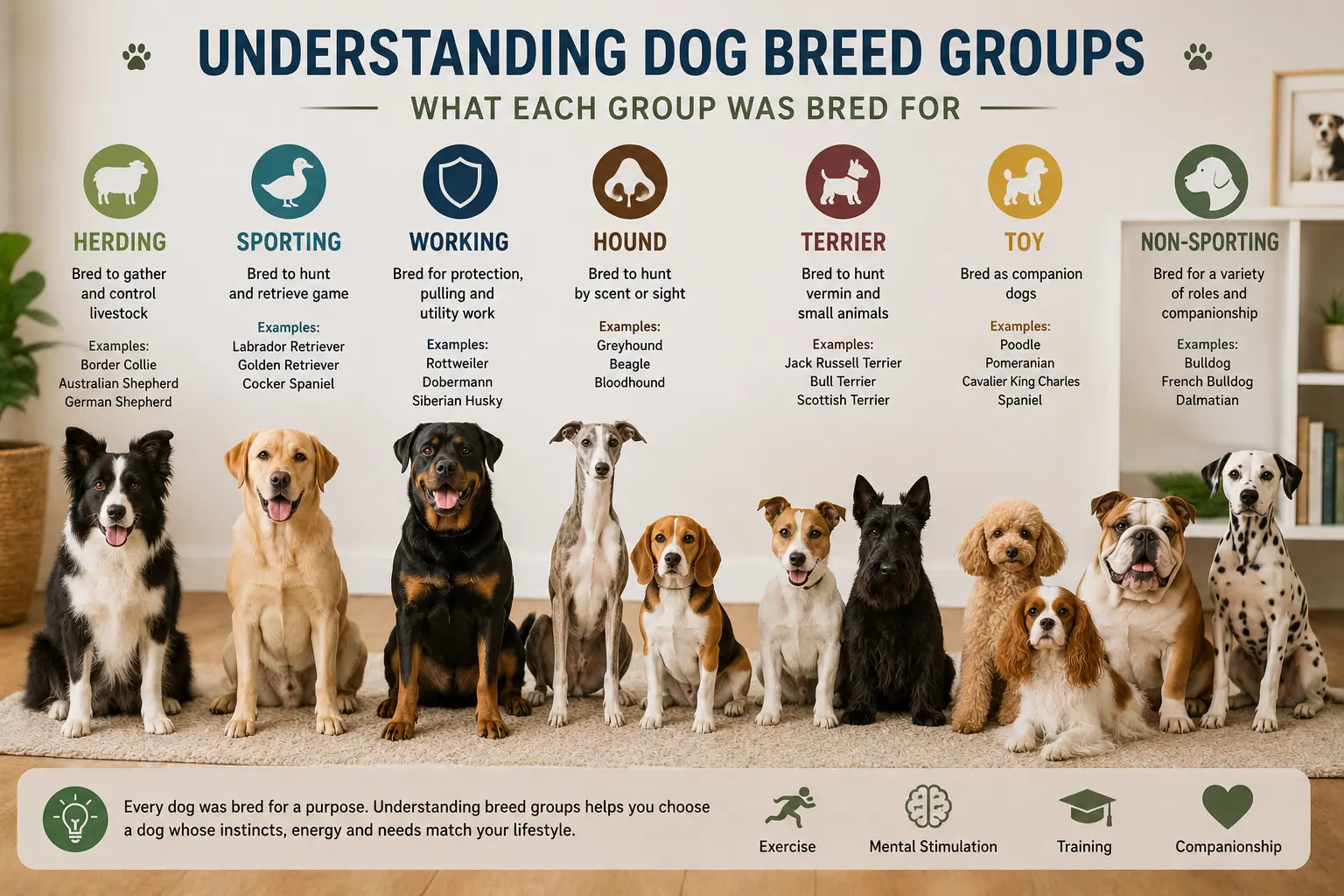
Dog breed groups are more than just an organizing system used by kennel clubs. They reflect the original purpose behind each breed, and that purpose still shows up in behaviour, energy levels, instincts, and training needs today. If you understand breed groups, you can make far better decisions about which dog is likely to fit your lifestyle, home, and experience level.
Many new owners choose a dog based on appearance alone. That is understandable, but it often leads to disappointment when the dog’s natural instincts are a poor match for the family’s routine. A breed that was developed to herd sheep, track scent, guard property, or retrieve game will not behave like a generic “pet dog,” even if it has been bred as a companion for generations.
This is why breed groups are so useful. They help explain not just what a dog looks like, but what the dog was designed to do. Once you know that, training, exercise, and enrichment become much easier to understand.
Why breed groups matter
Breed groups exist because dogs were developed for jobs. Some were bred to control livestock, others to hunt, some to guard, some to pull sleds, and some to sit beside people as companions. These working origins shape the dog’s instincts long after the original job is no longer part of daily life.
That does not mean every dog of a breed will behave exactly the same way. Individual temperament, socialisation, training, and breeding quality all matter. But breed history gives you a very useful starting point.
For example, a Border Collie often has strong movement sensitivity and intense focus, while a Labrador Retriever is typically more social and eager to work with people. A Greyhound may be quiet indoors but highly driven by movement outdoors. These differences are not random; they come from generations of selective breeding.
Herding group
Herding breeds were developed to move and control livestock. They needed intelligence, speed, responsiveness, and the ability to work closely with humans. Today, that often translates into dogs that are sharp, alert, trainable, and highly engaged with their environment.
Common herding breeds include Border Collies, Australian Shepherds, German Shepherd Dogs, Corgis, Shetland Sheepdogs, and Belgian Shepherds. Many of these dogs are excellent learners, but they also need a job to do. If they do not get enough mental and physical stimulation, they may invent their own work, which can include barking, chasing, herding children, or developing destructive habits.
Herding dogs are often a strong choice for active owners, dog sports, training enthusiasts, and families who can provide structure and routine. They may not be the best match for a very low-activity household. That does not make them “bad family dogs.” It simply means they need a lifestyle that suits their instincts.
What herding breeds need
- Consistent daily exercise.
- Brain work, not just walks.
- Training games and puzzle toys.
- Clear rules and routine.
- A household that enjoys engagement and activity.
Sporting group
Sporting breeds, also called Gundogs in many regions, were developed to assist hunters in finding, flushing, and retrieving game. This group includes breeds like Labrador Retrievers, Golden Retrievers, Spaniels, Setters, and Pointers. They are usually energetic, biddable, and highly motivated to work with people.
These are some of the most popular family dogs for good reason. Many sporting dogs are social, affectionate, and eager to please. They often do well in homes that can provide regular exercise, consistent training, and a lot of interaction with their people.
The downside is that many owners underestimate how much activity these dogs need. A bored sporting breed may become noisy, pushy, destructive, or restless. They often thrive when given activities that use both body and brain, such as fetch, scent games, obedience, swimming, or structured walks.
What sporting breeds need
- Daily exercise.
- Training that stays interesting.
- Opportunities to retrieve, sniff, or swim.
- Social time with the family.
- Enough mental work to prevent boredom.
Working group
Working breeds were developed for jobs such as guarding, pulling, rescue, and general utility work. This group includes dogs like Rottweilers, Dobermanns, Great Danes, Bernese Mountain Dogs, and Siberian Huskies. These dogs are often large, strong, and capable, with instincts that can be intense and powerful.
Many working dogs are excellent companions, but they are usually not “easy” dogs. They often need early socialisation, firm but fair handling, and an owner who understands how to manage strength, drive, and confidence. Some working breeds are natural guardians. Others have strong pulling or endurance instincts.
Because of their physical power, working breeds can be difficult for inexperienced owners who are not prepared to manage them properly. That does not mean first-time owners should never consider one, but it does mean the decision should be based on honest self-assessment rather than admiration alone.
What working breeds need
- Early and ongoing socialisation.
- Confident, consistent training.
- Physical activity and structure.
- Clear boundaries.
- An owner who can manage size and strength safely.
Hound group
Hounds were bred primarily for hunting. Some hunt by sight, while others hunt by scent. This creates a split within the group, but both types are typically independent and highly driven by instinct.
Sighthounds such as Greyhounds, Whippets, and Salukis were developed to chase moving quarry at speed. They can be surprisingly calm indoors but may need secure off-lead areas because once they see movement, their chase instinct can take over quickly. Scenthounds such as Beagles, Bloodhounds, and Dachshunds were bred to follow scent trails. They are often determined, focused, and difficult to distract once on a scent.
Hounds can be wonderful pets, but they are rarely “easy recall” dogs. Their instincts are real, and owners need to understand that obedience around distractions may take more patience than with some other groups.
What hounds need
- Safe fenced areas.
- Patience with recall training.
- Scent games and enrichment.
- Exercise suited to the type of hound.
- Realistic expectations about independence.
Terrier group
Terriers were bred to hunt vermin and, in many cases, to go to ground after quarry. This means they are often bold, energetic, persistent, and strong-minded. Examples include Jack Russells, Airedales, Scottish Terriers, and Bull Terriers.
Terriers often have huge personalities in compact bodies. They are usually entertaining, clever, and full of life, but they can also be stubborn, noisy, and highly prey-driven. They often do not back down easily, which can make them challenging for inexperienced owners who expect a small dog to be simple.
A terrier is often happiest when it has structure, activity, and clear outlets for its drive. If you give a terrier too little to do, it will often find its own project. That project may involve digging, chasing, barking, or redecorating your garden.
What terriers need
- Consistent boundaries.
- Prey-drive management.
- Enrichment and digging alternatives.
- Training that is short, fun, and clear.
- An owner who appreciates independence.
Toy group
Toy breeds were developed primarily as companions. They include breeds such as Maltese, Chihuahuas, Pomeranians, and Cavalier King Charles Spaniels. Even though they are small, many toy breeds are not low-energy or low-maintenance.
One of the most common mistakes owners make is assuming that a small dog needs less training or less exercise. In reality, many toy breeds need exactly the same structure, socialisation, and mental stimulation as larger dogs. The difference is that their size can make their behaviour easier for owners to overlook or excuse.
Toy breeds can be affectionate, portable, and highly bonded to their families. Some are sensitive and may be prone to anxiety or reactivity if they are overprotected, under-trained, or not properly socialised.
What toy breeds need
- Early socialisation.
- Training and routine.
- Careful handling and safety.
- Mental stimulation.
- Respect for their emotional needs, not just their size.
Non-sporting group
The non-sporting group is something of a mixed category. It contains breeds that do not fit neatly into other working categories. Depending on the kennel club system, this group may include breeds with very different histories, temperaments, and exercise needs.
Because the group is so varied, it is especially important to look at the individual breed rather than relying on the category alone. A Dalmatian, for example, has different needs from a Bulldog or a Poodle, even though they may appear under a broad non-sporting classification in some systems.
This is a reminder that breed group is a starting point, not a complete profile.
Breed group is only one part of the picture
It is important not to treat breed group as destiny. Within any breed, there are differences in temperament, energy, and trainability. The breeder’s approach, early socialisation, and individual personality all matter.
A well-bred dog from a responsible breeder is far more likely to match the breed’s typical behaviour than a poorly bred dog, but even then, the dog is still an individual. That is why it is wise to use breed group as a guide, not a guarantee.
When choosing a dog, ask yourself not just “Do I like how this dog looks?” but “Can I live with the instincts this breed was designed to have?” That question alone can prevent many future problems.
How to choose the right breed for your life
The best breed for you is not necessarily the one you admire most online. It is the one that fits your actual routine, home, experience, and energy level.
Ask yourself:
- How much exercise can I really provide every day?
- Do I want a highly trainable dog or a more independent one?
- Can I handle strong prey drive, barking, or guarding instincts?
- Do I want a dog that needs a lot of mental work?
- Will this dog fit my home, children, other pets, and schedule?
The more honest you are with these questions, the better your choice will be.
Frequently asked questions
Are all dogs in the same group the same?
No. Breed group gives you a general idea of purpose and instincts, but each breed and each dog is still individual.
Do breed groups apply to mixed-breed dogs?
Only loosely. Mixed-breed dogs may show traits from several groups depending on their ancestry.
Is one breed group better than another?
No. They are different, not better or worse. The right choice depends on the owner’s lifestyle and experience.
Why do some groups seem easier than others?
Some breeds were developed to be more cooperative with humans, while others were developed to work more independently. That changes how easy they can feel in everyday life.