
Understanding Cat Behaviour: What Your Cat Is Actually Telling You
Cats are often described as mysterious, but they are actually communicating constantly. The challenge is that their communication is subtle. If you learn how to read body language, tail position, ear angle, posture, and vocal changes, you can understand your cat far better and respond in ways that build trust instead of confusion.
Many behaviour problems are not really “bad behaviour” at all. They are signals. A cat that is hiding, swatting, knocking things off surfaces, or meowing more than usual is often trying to say something about stress, comfort, pain, boredom, or social preference.
Why cat body language matters
Unlike dogs, cats often do not broadcast emotions in obvious ways. They may show small, precise signs that owners miss unless they know what to look for.
That makes body language one of the most important tools for understanding cats. If you learn the basics, you can spot discomfort earlier, avoid conflict, and improve your bond.
The slow blink
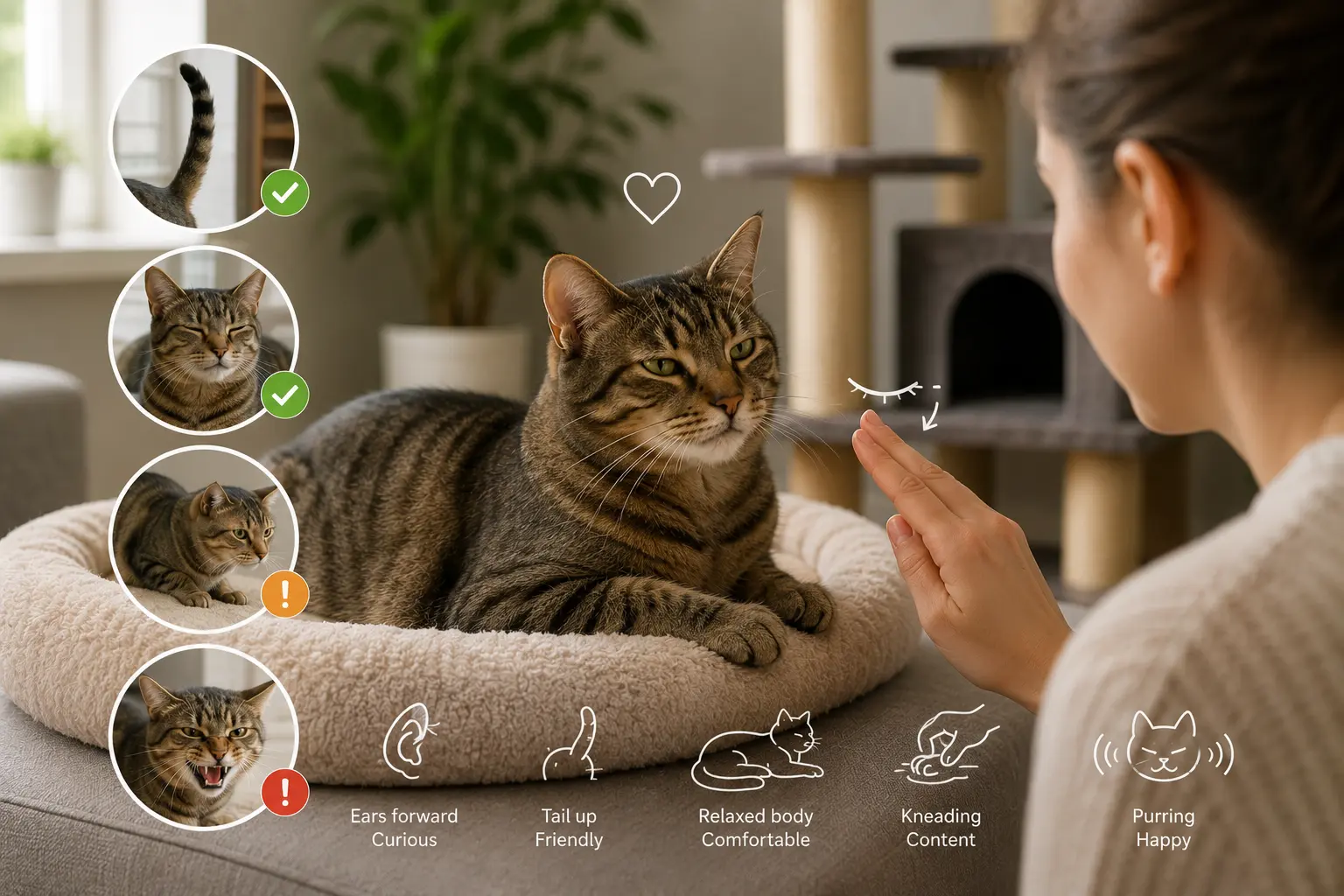
The slow blink is one of the clearest signs of trust and relaxation in cats. When a cat looks at you and slowly closes its eyes, it is often saying that it feels safe.
You can return the gesture by slowly blinking back. Many cats respond positively to this because it mirrors their calm social signal. It is a small thing, but it can strengthen your relationship over time.
Tail position
A cat’s tail can tell you a lot. A tail held upright is often a greeting or a sign of confidence. A slight curl at the tip can suggest friendliness or contentment.
A puffed-up tail usually signals fear or alarm. A lashing or thrashing tail often means irritation, tension, or overstimulation. That is different from a relaxed swish, which may simply mean focus.
In other words, the tail is not just decoration. It is one of the cat’s clearest emotional indicators.
Ear position
Ear position is another important clue. Forward ears usually suggest interest or curiosity. Sideways or flattened ears often indicate stress, fear, discomfort, or defensive feelings.
Because ear position can change quickly, it is useful to watch it along with the rest of the cat’s posture. A cat may look calm but still be showing subtle signs of tension.
Body posture
A relaxed cat often lies with a loose body, soft eyes, and even breathing. A tense cat may look crouched, narrow, or ready to move. If a cat is trying to make itself smaller, it may be anxious or unsure.
Stiffness matters too. A cat that seems rigid, guarded, or unwilling to settle may be uncomfortable physically or emotionally. Posture is often one of the earliest signs that something is wrong.
Kneading
Kneading is the rhythmic pushing of paws into a soft surface. It often appears when a cat is relaxed, content, or feeling safe. Many cats knead blankets, bedding, or people they trust.
It is often linked to kittenhood and early comfort behaviour, but in adult cats it usually remains a sign of emotional security. Some cats purr while kneading, which can make the signal even clearer.
Vocalisation
Cats vary enormously in how much they vocalise. Some breeds and individuals are naturally chatty, while others are quiet. A vocal cat is not automatically needy or unhappy; it may just be expressive.
What matters is change. If a cat that is usually quiet suddenly becomes very vocal, it may be trying to communicate pain, discomfort, anxiety, hunger, or a medical problem. Sudden vocal change in older cats deserves attention.
Why cats knock things over
This behaviour is often misunderstood. Sometimes it is curiosity. Sometimes it is play. Sometimes it is attention-seeking, because the cat has learned that knocking something over gets a reaction.
Cats are highly observant, and they quickly learn what works. If a behaviour reliably causes you to look, speak, or move, the cat may repeat it. That does not make the cat “mean.” It means the cat has learned a pattern.
Hunting and prey behaviour
Cats are natural hunters, even when they are well-fed indoors. Bringing home prey, stalking toys, pouncing, and stalking movement are all part of normal feline behaviour.
If your cat brings you prey, it is usually not being cruel. It is acting according to instinct. While you may not enjoy the gift, the behaviour itself is a normal expression of feline hunting drive.
Signs of stress
A stressed cat may hide more, eat less, groom excessively, become reactive, or change its usual social patterns. Some cats become clingier, while others become withdrawn.
Stress can come from many things: moving house, new pets, loud noises, changes in routine, conflict with another animal, or illness. Because cats are sensitive to environmental change, owners often need to be more observant than they expect.
When behaviour changes may signal illness
If a cat suddenly becomes more vocal, less social, more aggressive, or changes its eating or litter tray habits, a veterinary check is important. Behaviour changes can be one of the first signs that something physical is wrong.
Cats are experts at hiding illness. By the time they look obviously unwell, the problem may already be advanced. That is why changes in behaviour should never be ignored.
How to build a better bond with your cat
You do not need to force affection. Cats usually trust best when they are given choice and control. Let the cat approach first, respect their retreat space, and use calm signals rather than loud or sudden movement.
Helpful habits include:
- allowing safe hiding places.
- using slow blinks.
- respecting tail and ear signals.
- avoiding rough handling.
- keeping routine stable.
- providing play and enrichment.
A cat that feels secure is more likely to be affectionate on its own terms.
Frequently asked questions
Why does my cat stare at me?
Cats may stare to assess their surroundings, observe you, or communicate interest. The rest of the body language will tell you whether the stare is relaxed or tense.
Is my cat angry when its tail flicks?
Not always, but fast tail movement often means irritation, excitement, or overstimulation. Context matters.
Why does my cat knead me?
Usually because it feels safe and relaxed. It is generally a comfort behaviour.
When should I worry about cat behaviour?
If the change is sudden, severe, or paired with appetite, litter, mobility, or vocal changes, a vet visit is wise.